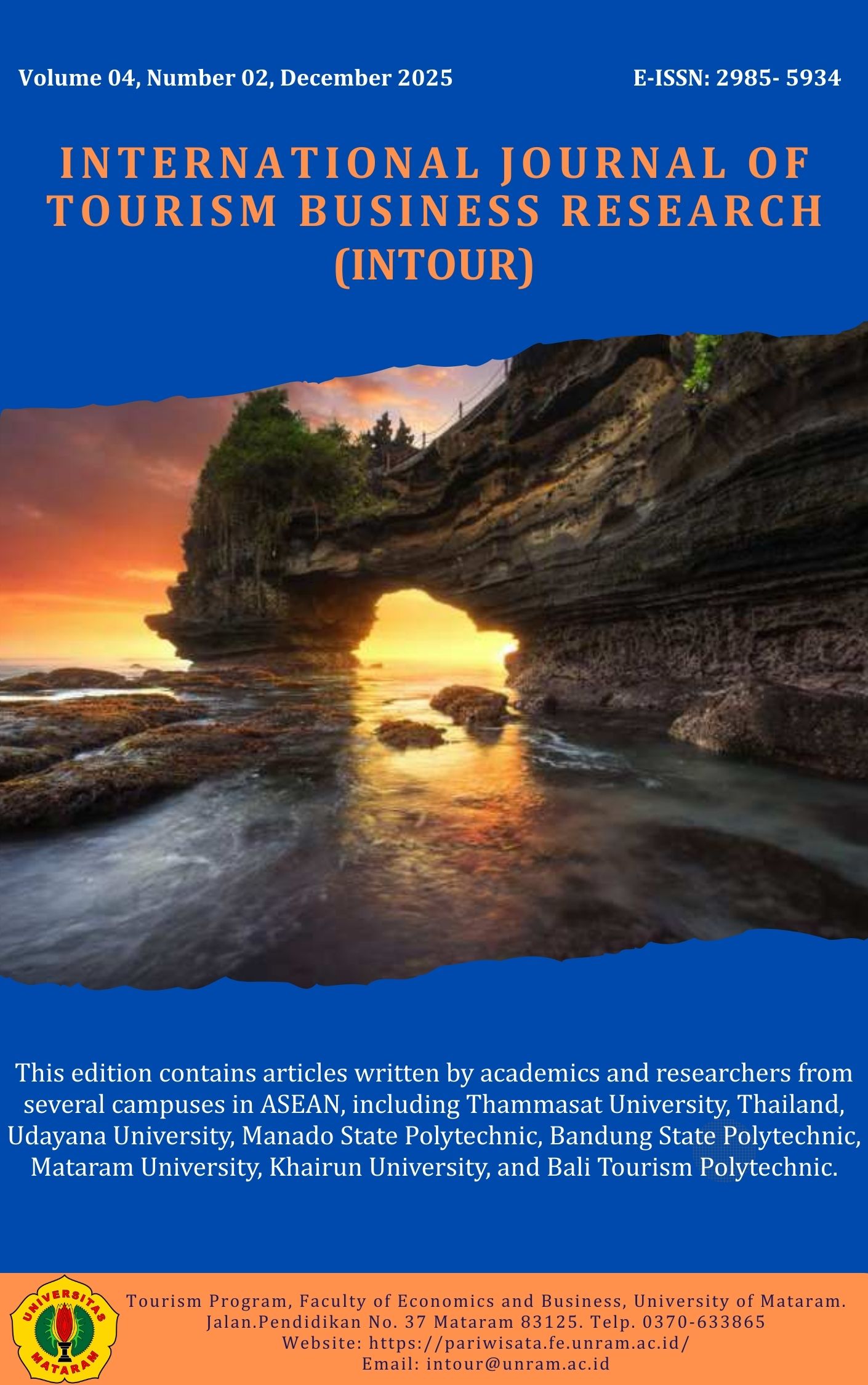
Understanding the Tourism Area Life Cycle and Sustainability Perceptions in the Rural Destination of Kintamani, Bali
DOI:
https://doi.org/10.29303/intour.v4i2.2555Keywords:
tourism area life cycle, sustainability perception, rural tourism, BaliAbstract
This study examines the dynamics of tourism development and sustainability perceptions in Kintamani, Bali, using the Tourism Area Life Cycle (TALC) model. Kintamani, a rural highland destination, has experienced rapid growth in tourism activities, from mass visitation to niche experiences such as glamping and coffee tourism. Despite its popularity, limited research addresses its current life cycle stage and visitors’ sustainability views. A mixed-method approach was applied, combining surveys of 100 domestic and international tourists with in-depth interviews involving six key stakeholders, including local business owners, community leaders, and government representatives. Findings reveal that Kintamani is transitioning from the development to consolidation stage, marked by increasing infrastructural pressures and socio-environmental challenges. While visitors value the area’s natural and cultural assets, they express concerns over waste management and overcrowding. The integration of TALC and sustainability perceptions offers a framework for adaptive destination in rural Bali.
References
Agarwal, S. (2002). Restructuring seaside tourism: The resort lifecycle. Annals of Tourism Research, 29(1), 25–55. https://doi.org/10.1016/S0160-7383(01)00002-0
Arida, I. N. S., Saputra, I. G. G., & Sanjiwani, N. M. G. (2025). Deconstructing the myths of village tourism in Bali: Development constraints and recommendations for collaborative models based on local wisdom to enhance existence. In P. D. S. Pitanatri & A. Hassan (Eds.), Handbook of Sustainability in Tourism and Hospitality in Indonesia (pp. 529–555). Springer. https://doi.org/10.1007/978-981-96-3379-1_20
Butler, R. W. (1980). The concept of a tourist area cycle of evolution: Implications for management of resources. Canadian Geographer, 24(1), 5–12. https://doi.org/10.1111/j.1541-0064.1980.tb00970.x
Cohen, E. (1984). The sociology of tourism: Approaches, issues, and findings. Annual Review of Sociology, 10, 373–392. https://doi.org/10.1146/annurev.so.10.080184.002105
Doxey, G. V. (1975). A causation theory of visitor-resident irritants: Methodology and research inferences. In Proceedings of the Travel Research Association 6th Annual Conference (pp. 195–198). San Diego, CA: Travel Research Association.
Gartner, W. C. (1996). Tourism development: Principles, processes, and policies. New York, NY: Van Nostrand Reinhold.
Getz, D. (1992). Tourism planning and destination life cycle. Annals of Tourism Research, 19(4), 752–770. https://doi.org/10.1016/0160-7383(92)90065-W
Hall, C. M. (2008). Tourism planning: Policies, processes and relationships (2nd ed.). Harlow, England: Pearson Education.
Kintamani District Tourism Office. (2023). Tourism statistics report 2019–2023. Bangli: Kintamani Tourism Board.
Lane, B., & Kastenholz, E. (2015). Rural tourism: The evolution of practice and research approaches—Towards a new generation concept? Journal of Sustainable Tourism, 23(8–9), 1133–1156. https://doi.org/10.1080/09669582.2015.1083997
Saputra, I. G. G. (2016). Respon wisatawan terhadap pengembangan Batur Global Geopark Bali. Denpasar: Universitas Udayana. Retrieved from https://www.academia.edu/94542206/Respon_Wisatawan_Terhadap_Pengembangan_Batur_Global_Geopark_Bali
Saputra, I. G. G., & Pitanatri, P. D. S. (2023). Digital acceptance and resilience in rural tourism destination: A case of Bali. In A. Hassan, A. Sharma, J. Kennell, & P. Mohanty (Eds.), Tourism and Hospitality in Asia: Crisis, Resilience and Recovery (pp. 275–296). Springer. https://doi.org/10.1007/978-981-19-5763-5_18
Sharpley, R. (2002). Rural tourism and the challenge of tourism diversification: The case of Cyprus. Tourism Management, 23(3), 233–244. https://doi.org/10.1016/S0261-5177(01)00078-4
Smith, V. L. (1989). Hosts and guests: The anthropology of tourism (2nd ed.). Philadelphia, PA: University of Pennsylvania Press.
UNESCO. (2022). Batur UNESCO Global Geopark: Annual report 2022. Paris: UNESCO Publishing.
Weaver, D., & Lawton, L. (2014). Tourism management (5th ed.). Milton, QLD: John Wiley & Sons.
Downloads
Published
How to Cite
Issue
Section
License
Copyright (c) 2025 I Gede Gian Saputra, I Gusti Agung Pradnyadari, Ida Bagus Udayana Pidada

This work is licensed under a Creative Commons Attribution-ShareAlike 4.0 International License.
1.png)